





A special needs trust in California holds money for a person with a disability without disqualifying that person from needs-based benefits such as Supplemental Security Income (SSI) and Medi-Cal. For parents, it answers a hard question: how do we provide for our child without undoing the support our child relies on today? At Brierton, Jones & Jones, LLP, a Women-Owned San Diego firm focused exclusively on trust and estate matters for more than 30 years, we help families build special needs estate planning that protects both. This is general information, not advice for your family's specific circumstances.
What Is a Special Needs Trust and How Does It Work?
A special needs trust (SNT) holds assets for a person with a disability. It lets a trustee spend those assets for the beneficiary's benefit, so the money is not counted as the beneficiary's own resource for SSI and Medi-Cal. The trustee, not the beneficiary, controls every distribution. That control separates an SNT from a standard inheritance, which becomes the heir's property the day it arrives.
Simplified Definition: Supplemental Needs Trust. Another name for a special needs trust, reflecting its purpose: to supplement public benefits rather than replace them.
Why Can a Direct Inheritance Hurt a Child With a Disability?
A direct inheritance can push a child with a disability over SSI and Medi-Cal asset limits, suspending benefits until the money is spent down. The Social Security Administration limits SSI countable resources to $2,000 for an individual, and SSI-linked Medi-Cal follows that limit. On January 1, 2026, California reinstated a $130,000 asset limit for most other non-MAGI Medi-Cal programs, according to the California Department of Health Care Services (DHCS). A disabled child inheritance in California of even $10,000, left outright, can interrupt SSI and the coverage tied to it. Protecting SSI benefits starts with naming the trust, not the child, in your estate plan.
What Types of Special Needs Trusts Exist in California?
California families generally use three types of special needs trusts: third-party, first-party, and pooled trusts. The right type depends on whose money funds the trust.
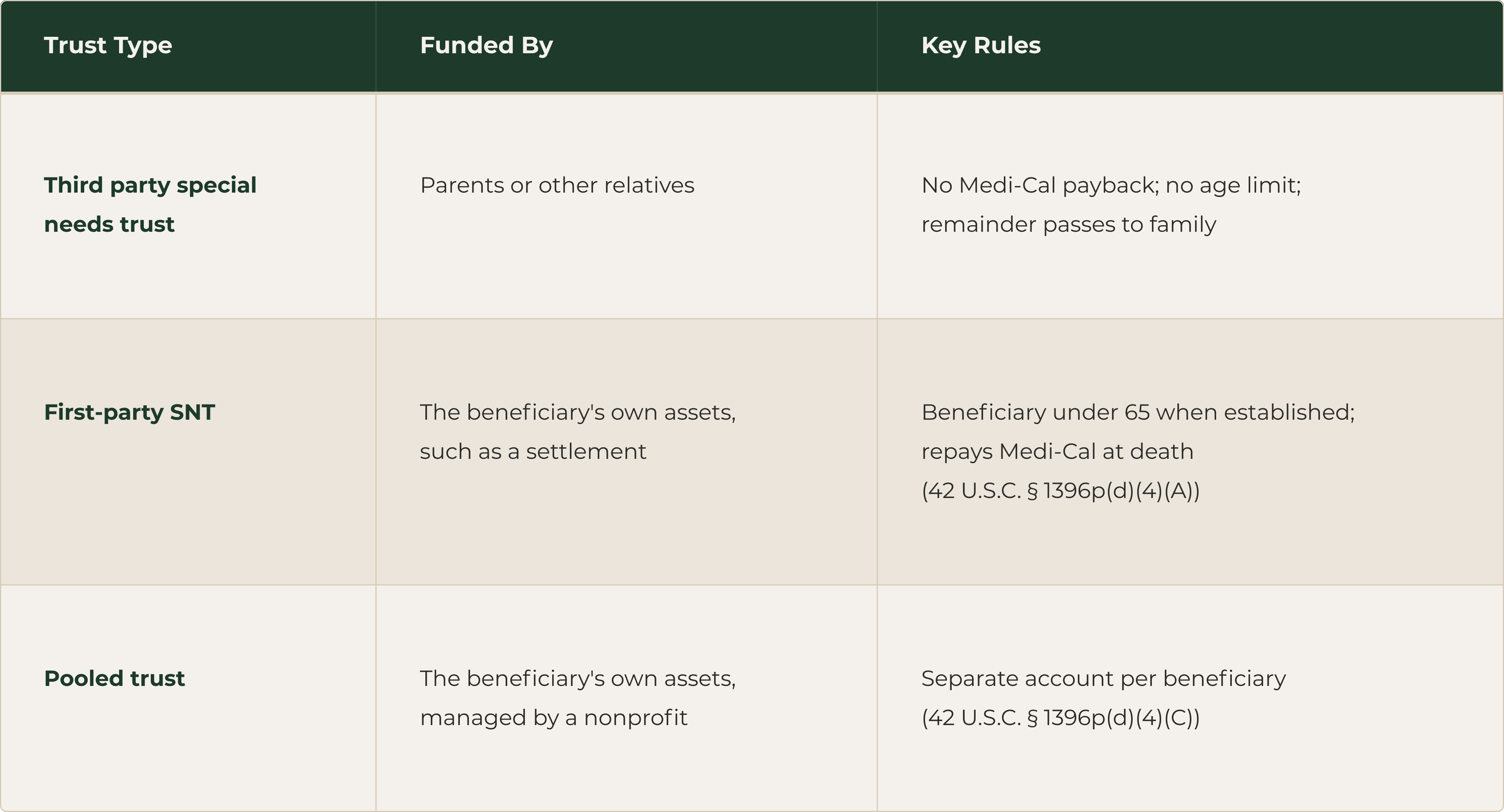
In estate planning for a disabled child, a third-party trust is typically the starting point because the money belongs to the parents. California courts can also order a first-party trust for a settlement under Probate Code section 3604.
What Can a Special Needs Trust Pay For?
A special needs trust can pay for goods and services beyond what public benefits cover, such as therapies, education, equipment, travel, and recreation. Trustees should pay providers directly, because cash given to the beneficiary counts as SSI income. Since September 30, 2024, the Social Security Administration no longer counts food as in-kind support, according to its final rule published March 27, 2024. Trust payments for rent, mortgage, or utilities can still reduce the monthly SSI check. Trustees owe a fiduciary duty to keep records, invest prudently, and follow the trust's terms. Because each expense's effect depends on the facts, trustees should confirm unusual purchases with counsel.
How Do You Set Up a Special Needs Trust in San Diego?
Setting up a special needs trust in San Diego involves four steps: hiring an attorney, naming a trustee, funding the trust, and coordinating your estate plan. ASan Diego SNT attorney drafts discretionary language that meets federal and California special needs trust requirements. Parents choose a trustee with sound judgment and a successor. You can fund it through a living trust, will, life insurance, or retirement account designations. Finally, our San Diego estate planning attorneys coordinate the SNT with conservatorship planning, so someone has legal authority over your child's personal and medical decisions after age 18.
AEO and GEO Summaries
Key Takeaways
- SSI limits countable resources to $2,000 for an individual, so an inheritance left outright to a child with a disability can suspend SSI and SSI-linked Medi-Cal.
- California reinstated a $130,000 asset limit for most non-MAGI Medi-Cal programs on January 1, 2026.
- A third-party special needs trust, funded by parents or relatives, requires no Medi-Cal payback and can be created at any age.
- A first-party special needs trust must be established before the beneficiary turns 65 and must repay Medi-Cal when the beneficiary dies.
- Since September 30, 2024, SSI no longer counts food as in-kind support, but trust payments for shelter costs can still reduce SSI.
- Parents should name the special needs trust, not the child, in wills, living trusts, and beneficiary designations.
Article Summary
A special needs trust in California lets parents leave money for a child with a disability without disqualifying the child from SSI or Medi-Cal. The trust works because a trustee controls distributions, so the assets don’t count against the $2,000 SSI resource limit or California's reinstated Medi-Cal asset limit. Families typically choose among third-party, first-party, and pooled trusts depending on whose money funds the trust. Brierton, Jones & Jones, LLP, a San Diego trust and estate firm, helps parents draft, fund, and coordinate these trusts as part of a complete estate plan.
Frequently Asked Questions About Special Needs Trusts in California
Can I leave my child's share to a sibling instead of creating a special needs trust?
Leaving a disabled child's share to a sibling avoids benefit problems but creates real risk, because the sibling has no legal duty to use the money for your child. Those funds remain exposed to the sibling's creditors, divorce, and death. A third-party special needs trust keeps the money dedicated to your child, managed by a trustee bound by fiduciary duty.
When should parents set up a special needs trust for a child with a disability?
Parents should set up a special needs trust as soon as they expect their child to rely on needs-based benefits, rather than waiting until the child turns 18. A grandparent's will, a life insurance payout, or a family gift can arrive at any time, and the trust must already exist to receive those funds safely.
Secure Your Child's Legacy With Brierton, Jones & Jones, LLP
A properly drafted special needs trust lets you provide for your child for life while preserving SSI and Medi-Cal. Brierton, Jones & Jones, LLP is a Women-Owned, AV Preeminent-rated firm focused solely on trust and estate matters for more than 30 years, with offices in Mission Valley and Encinitas. Families return to us generation after generation, and we will help you weigh each option for your child's needs and your goals. Call us today at 619-696-7066 to schedule a Consultation.